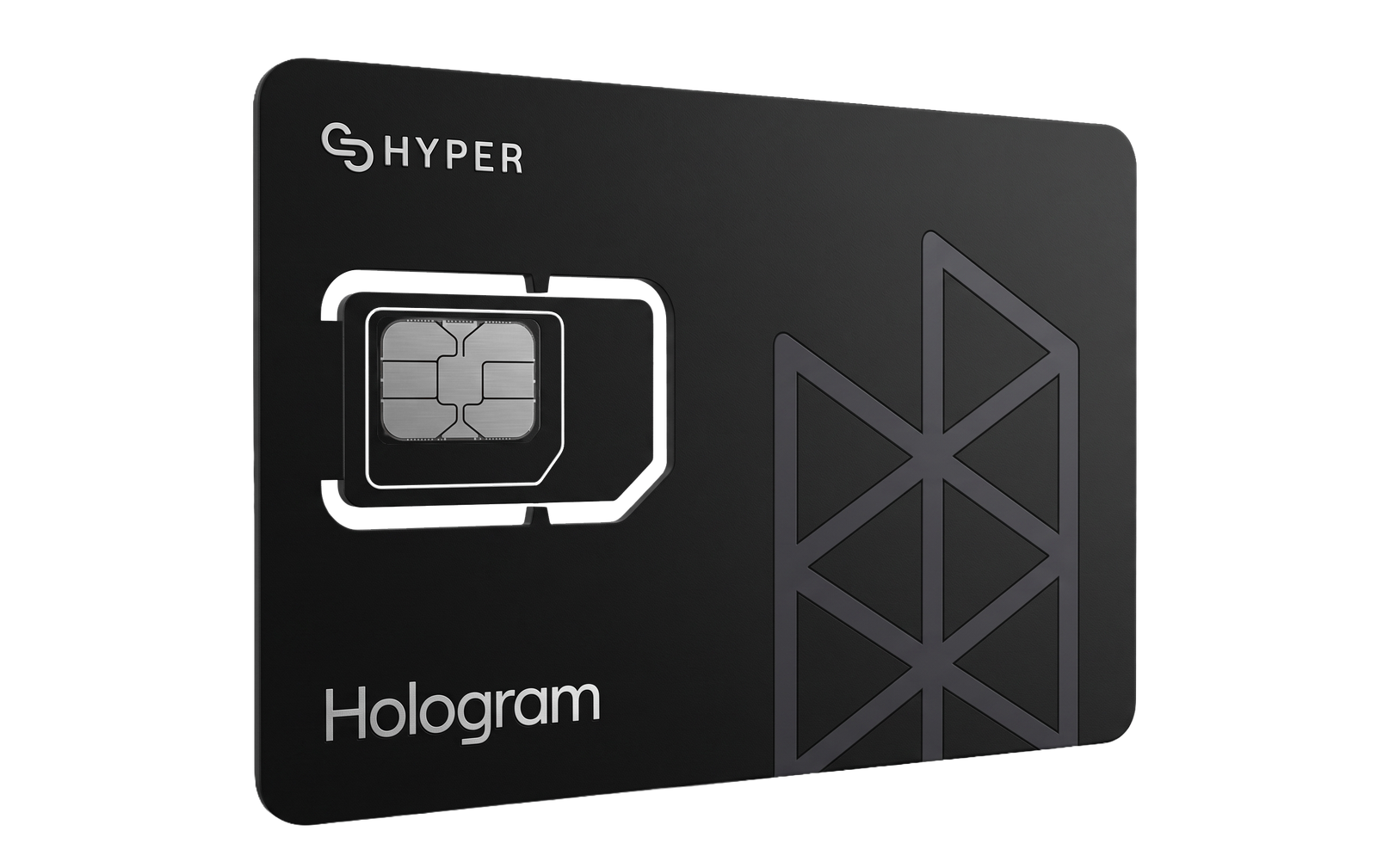
Ship one SIM, connect anywhere.
IoT SIM Cards
Hologram Hyper SIMs connect your fleet to 550+ carriers in 190+ countries, with built-in Outage Protection and remote SIM management. Scale from first prototype to millions of devices.
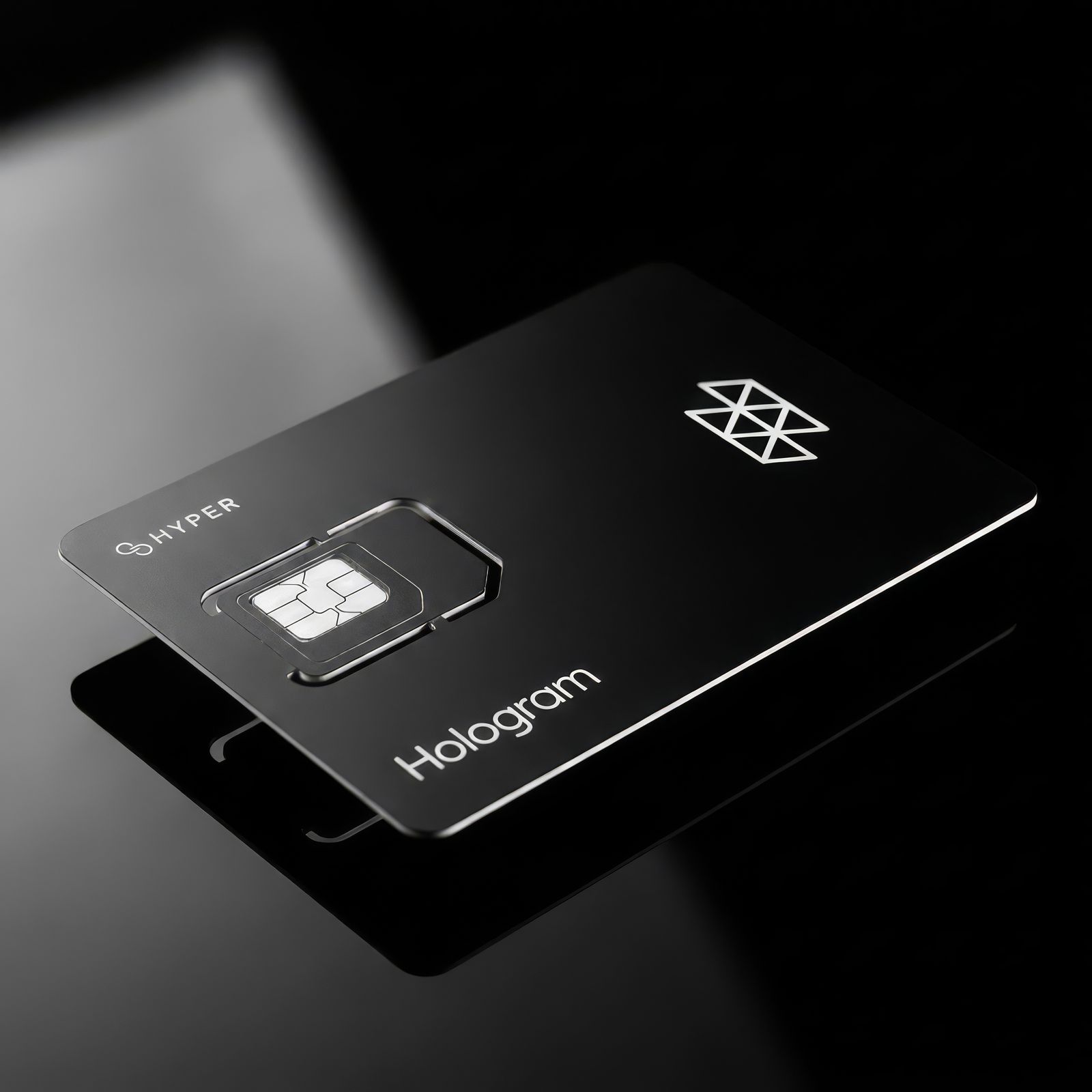
Connect anywhere.
One SIM reaches 550+ carrier networks across 190+ countries and territories.
Ship in days.
Activate SIMs from the dashboard or API without waiting on a sales call.
Budget with confidence.
Transparent usage-based pricing, with scaling volume discounts.
Switch remotely
Change carrier profiles over the air, with no truck roll or SIM replacement.
Stay online.
Add Outage Protection for a second mobile core and a 99.95% uptime SLA.
How Hyper SIMs keep fleets connected
Connect on the optimal network

Change carriers over the air

Access a second mobile core

One platform, every SIM standard
SGP.32 SIMs
Remote profile management built for scale. The most control Hologram offers over fleet connectivity.
SGP.02 SIMs
The proven choice for M2M fleets. Reliable remote provisioning for devices with consistent connectivity.
eSIM
Built for connected consumer devices, gateways, and enterprise hardware with embedded eSIM support.
SIM card specifications
Hyper SIM – SGP.02
Triple cut format
- Mini (2FF): 25mm × 15mm × 0.71 mm
- Micro (3FF): 15mm × 12mm × 0.71 mm
- Nano (4FF): 12.3mm × 8.8mm × 0.71 mm
Embedded SIM (eSIM) format
- MFF2 (DFN8): 6 × 5 × 0.82 mm
Operating characteristics
- Electrical: 1.62V to 5V
- Operational temperature: -40°C to +105°C (Industrial grade)
- Available memory: 414,384 bytes
- eUICC: SGP.02 v4.2
- Radio Access Technologies: 5G, 4G (LTE), 3G, 2G, NB-IoT, LTE-M
Download the datasheets:
SGP.02 Hyper SIM (Triple cut)SGP.02 Hyper SIM (Embedded)Hyper SIM – SGP.32
Triple cut format
- Mini (2FF): 25mm × 15mm × 0.71 mm
- Micro (3FF): 15mm × 12mm × 0.71 mm
- Nano (4FF): 12.3mm × 8.8mm × 0.71 mm
Embedded SIM (eSIM) format
- MFF2 (DFN8): 6 × 5 × 0.82 mm
Operating characteristics
- Electrical: 1.62V to 5V
- Operational temperature: -40°C to +105°C (Industrial grade)
- Available memory: 318,936 bytes
- eUICC: SGP.32 v1.2, SGP.22 v2.5
- Radio Access Technologies: 5G, 4G (LTE), 3G, 2G, NB-IoT, LTE-M
Download the datasheets:
SGP.32 Hyper SIM (Triple cut)SGP.32 Hyper SIM (Embedded)Additional SIM Types
Additional SIM types including downloadable SGP.22 eSIMs and FWA SIMs are available to contracted customers. To request a datasheet or more information, please contact sales. Datasheets for our older SIMs can be found here.
Start building today.
Free SIM included.
Sign up for a free Hologram account and claim your free Hyper SIM card. Includes test data and full software access and API access from the moment you activate.
Includes
- Global IoT SIM card
- Full software access
- Free test data
- REST API
- 550+ carriers in 190+ countries
- 5G, 4G LTE, 3G, 2G, LTE-M, NB-IoT
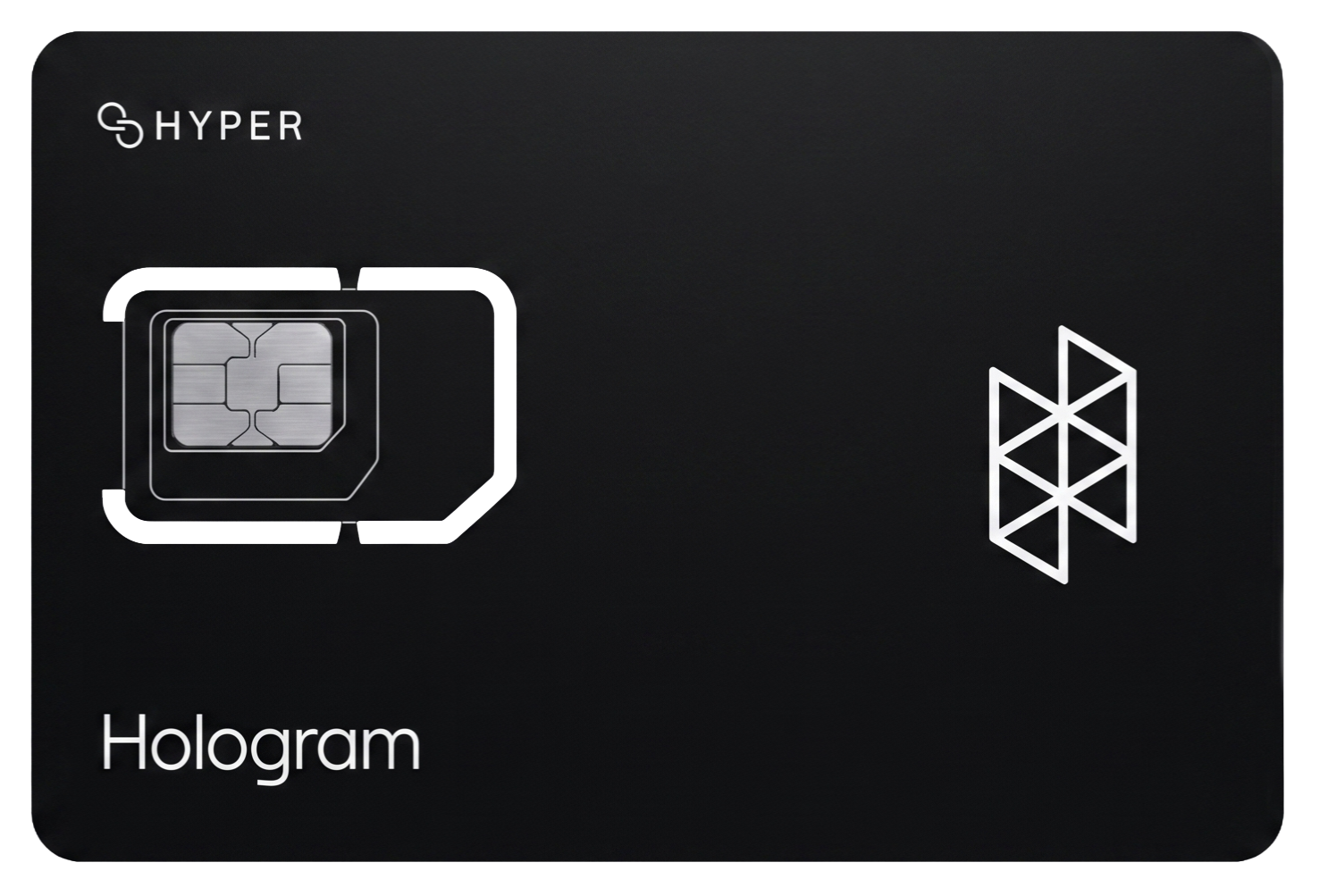
Ship one SIM, connect anywhere
—Luke Saunders, Founder and CEO, Farmer's Fridge

“The ROI with Hologram has been exceptional. We were able to cut our IoT bills in half.”
Luke Saunders
Founder and CEO, Farmer's Fridge
Frequently asked questions
What is an IoT SIM card?
Unlike a traditional SIM, an IoT SIM card is designed to send and receive data rather than enable voice calls. With more memory and durability than their consumer counterparts, IoT SIM cards also last longer—up to 10 years or more. They’re able to withstand environmental challenges like vibration, corrosion, and extreme temperatures.
How do IoT SIM cards work?
An IoT SIM card contains a contact chip encased in plastic. The chip stores distinctive information about the device, such as credentials and carrier data, and links the device to the network. IoT SIM cards are able to operate more independently than consumer SIMs. Unlike traditional SIMs, they don’t need human interaction on the device side to be activated. Some IoT SIMs can be provisioned remotely with eUICC (embedded universal integrated circuit card) technology.
Are IoT SIM cards tied to a single carrier network?
It depends on the card. Hologram's SIM cards are global and able to connect to the best networks available, anywhere in the world.
What is eUICC?
eUICC stands for embedded universal integrated circuit card. This is the technology that allows a SIM card to enable more than one subscriber profile over its lifecycle. (Carrier “subscriber profiles” indicate that a device has an account and can work on their network.) If your SIM card is eUICC-enabled, you can switch between cellular carrier profiles without ever needing to physically swap out the SIM card.
eUICC is the software that makes this possible. But for eUICC to work, you must use the right hardware — in this case, an eUICC SIM card that can support all the necessary profile management operations and additional memory.
Basically, eUICC SIMs act as a digital wallet that lets you use several different “credit cards” (or subscriber profiles), all on the same eUICC SIM card.
What is SGP.32?
SGP.32 is the newer GSMA standard for remote SIM management, designed specifically for IoT deployments. Where the earlier SGP.02 standard relies on a push-based model, SGP.32 uses a pull-based architecture — meaning the SIM initiates profile updates rather than waiting to receive them. This makes large-scale profile operations more reliable, particularly in environments with intermittent connectivity. Hologram's SGP.32 Hyper SIMs are now available in limited quantities.
What is SGP.02?
SGP.02 is the original GSMA standard for M2M remote SIM provisioning. It uses a push-based model where a central subscription manager initiates profile operations. Well-established and widely deployed, SGP.02 is the right choice for fleets with consistent connectivity or teams expanding an existing M2M deployment. Hologram Hyper SIMs support SGP.02, and Conductor handles SGP.02 profile lifecycle management alongside SGP.32 in mixed fleets.
What is Conductor?
Conductor is Hologram's SIM orchestration software. It works with Hologram Hyper SIMs to automate profile lifecycle management, define failover rules, and recover connectivity without physical device access across fleets of any size. SGP.32 Hyper SIMs unlock Conductor's full feature set.
What’s the difference between eSIM and eUICC?
The eSIM is the hardware component, and the eUICC is the software component or operating system that allows for over the air (OTA) profile updates. An eSIM is ideal for IoT devices that may be exposed to harsh conditions because it can be soldered directly to the board and vacuum sealed to minimize exposure. This soldering also allows for smaller form factors with fewer pieces. If you are developing a device that needs to last, an eUICC-compatible eSIM can ensure long-term usability. Our embedded SIMs (eSIMs) are available in MFF2 (DFN8) formats.
Which form factors do IoT SIM cards come in?
IoT SIM cards come in all the traditional form factors: 2FF, 3FF, and 4FF. You can also choose MFF2 if you want the SIM to be embedded in your device and to include over the air (OTA) provisioning capabilities.
Are your IoT SIM cards secure?
Every Hyper SIM includes powerful security features like Private APN, fraud detection, and device locking.
Get started with Hologram today
IoT SIM cards
Hologram Hyper SIMs give your fleet automatic access to 550+ carriers across 190+ countries, with built-in Outage Protection and remote SIM management that scales from first prototype to millions of devices.